Orchestrator
NLP input is parsed into intent, constraints, data requirements, and expected output before the orchestrator selects the right worker.
L205 ACS Master module
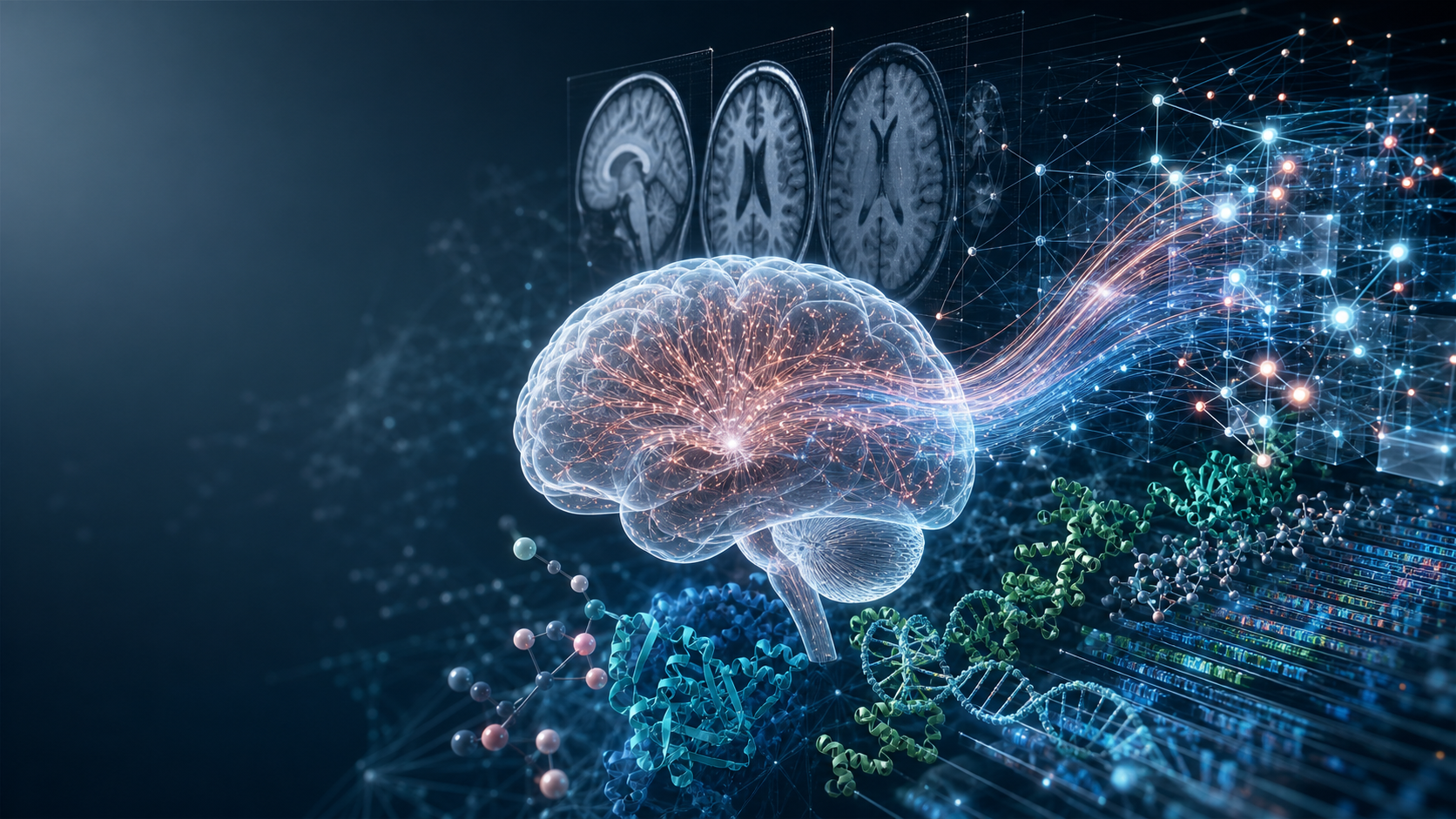
A research-led module on how neuroscience can inspire new AI systems, and how modern AI can reveal structure, mechanism, and clinically meaningful patterns in brain, multi-omics, imaging, and language data.
Course idea
The module connects brain anatomy, connectomes, neuroimaging, multi-omics, clinical big data, deep learning, graph learning, large language models, and translational applications. The aim is not only to predict outcomes, but to understand where predictive power comes from (explanation and explainable-AI).
Feature importance, saliency, Grad-CAM, SHAP, GNNExplainer, and biomarker validation for models working with neuroimaging, neurobiology, and medical language.
Information flow inside models, sparse autoencoders, superposition, polysemantic features, and circuit-level explanations for medical LLMs and biology.
Catastrophic forgetting, model collapse, continual learning, replay, LoRA, and neuroscience foundations of memory in human and artificial systems.
Preview
A curated recap of the key scientific concepts from last year’s module.
Agentic-AI highlight
This paradigm presents how the design of AI agents can draw inspiration from neuroscience. Conversely, interpreting the roles of coordinating orchestrators and specialised worker agents may provide useful computational hypotheses for understanding brain function. These connections underscore the importance of the module and demonstrate how its concepts can be translated into broader research and practical applications.
The video starts with a schematic brain-to-agent map, then follows user language through an orchestrator, specialised workers, reasoning, XAI, validation, memory, and catastrophic forgetting.
NLP input is parsed into intent, constraints, data requirements, and expected output before the orchestrator selects the right worker.
Specialist workers retrieve evidence, run models, analyse outputs, and return reasoning traces that can be inspected.
Validity comes from task checks, benchmarks, regression tests, uncertainty, attributional XAI, and mechanistic interpretability.
Continual learning can damage older skills. Replay, regularisation, adapters, monitoring, and drift tests help mitigate catastrophic forgetting.
Syllabus
Lobes, sulci, folding patterns, structural and functional MRI, and extracting connectome information from imaging data.
Genomics, transcriptomics, proteomics, metabolomics, microbiome layers, cellular heterogeneity, and AI-driven integration.
MLPs, CNNs, transformers, attention, ViT, graph representations, GCNs, GATs, and connectomic graph learning.
Large clinical datasets, UK Biobank-style pipelines, population-level neuroscience, and clinically grounded discovery.
Continual learning, replay, regularization, HAT, gradient memory, LoRA, model collapse, and cognitive neuroscience parallels.
Grad-CAM, SHAP, GNNExplainer, saliency, feature importance, and explainability in m-LLMs, neuroimaging, and neurobiology.
Superposition, polysemanticity, privileged bases, sparse autoencoders, information flow, and biological model explanations.
Clinical case studies, translational decision support, invited research and industry perspectives, and integrated AI-neuroscience workflows.
Assessment
A 30-minute, in-class, closed-book test after Lecture 5 and before Lecture 7, focused on the fundamental concepts introduced in Lectures 1 to 5.
A pair-based project with a 4,000-word report. Students may propose a project or select from structured topics provided at the start of term.
A short presentation on individual contributions, followed by a brief viva to discuss decisions, results, interpretation, and project ownership.
Project fairness is supported through report contribution statements, individual teammate contribution statements, two dedicated progress discussion sessions, and first-line PhD student support for project questions.
Learning outcomes
Reading and tools
Deep Learning, Ian Goodfellow, Yoshua Bengio and Aaron Courville
Graph Representation Learning, William L. Hamilton
Graph Neural Networks: Foundations, Frontiers, and Applications, Lingfei Wu et al.
Changing Connectomes, Marcus Kaiser
Principles of Neurodynamics, Frank Rosenblatt
Mind in Motion, Barbara Tversky
Cognitive Foundations of Agentic AI, Anand Vemula
Machine Learning: A Probabilistic Perspective, Kevin P. Murphy